


I have already written about good 1:1s, developing PMs, and performance assessment.
But when someone is not meeting expectations, there is a very practical question you need to answer before jumping to feedback, a development plan, or a performance-improvement process:
What is actually stopping this person from doing the thing?
To help with that, I use a small framework I am calling BUMS.
Yes, BUMS.
Because product management does not have enough acronyms already, and because apparently I am still 12 years old.
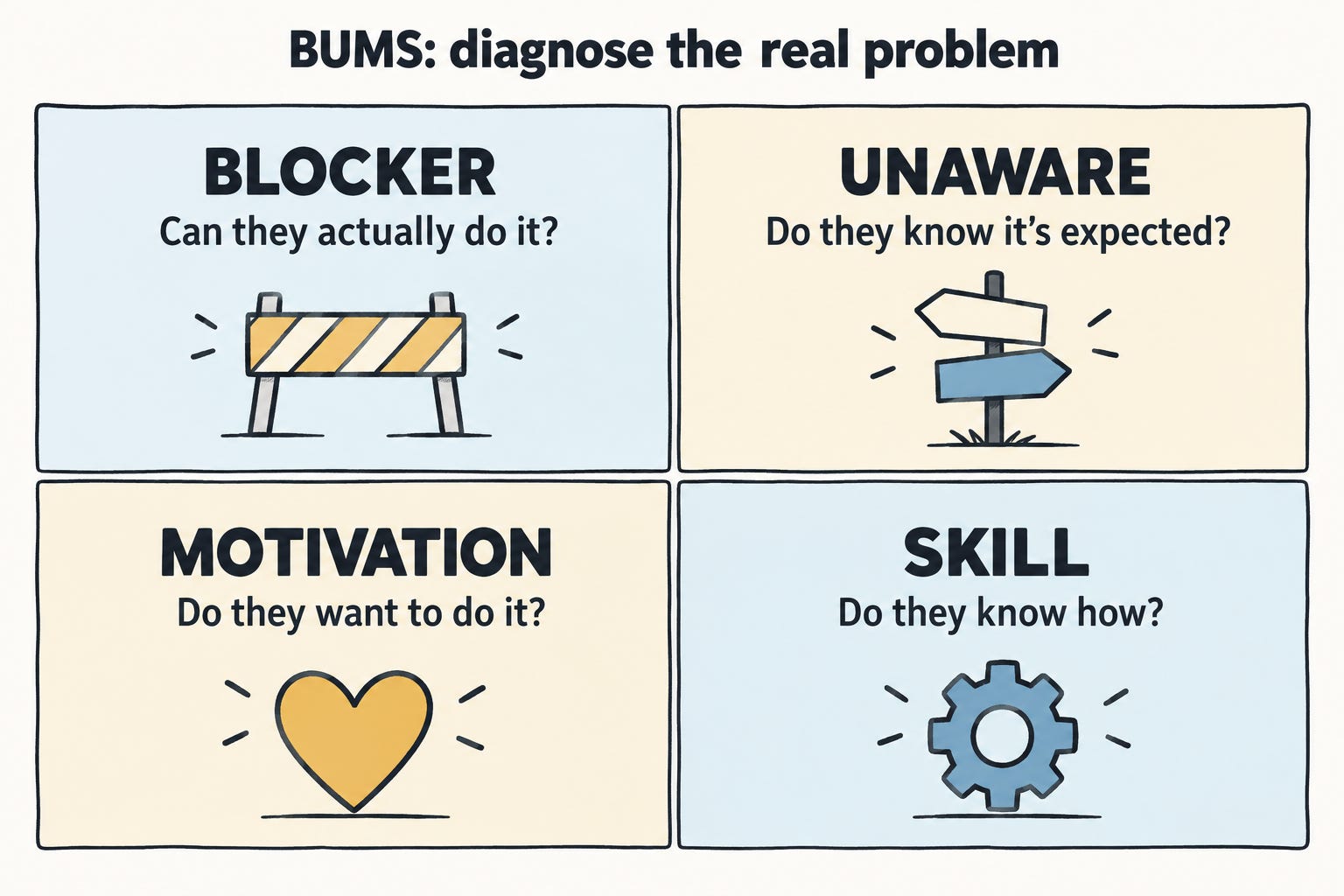
BUMS stands for:
Blocker
Unaware
Motivation
Skill
When a PM is not doing what is expected, these are the first four places I look. Sometimes there is more than one issue. But usually, one of them is the real reason things are stuck.
What is a template?
Templates are reusable content blocks you can insert into any post. Use them for content you repeat often, like:
Standard disclaimers or disclosures
Calls to action (subscribe, share, etc.)
Custom dividers or recurring sections
Post templates or boilerplate
To create a template, click "Template" in the editor toolbar and select one to insert. You can organize templates into groups by using "/" in the name (e.g. "Email/Welcome").
B — Blocker
The person can do the work, but there is a barrier making progress impossible or ridiculously hard.
This is where bad leaders often make a mistake: they see a PM failing to deliver, conclude that the PM is weak, and start coaching them on “ownership.”
Meanwhile, the PM is trying to move a truck through a wall.
Some common blockers:
A senior leader is actively blocking the work.
For example, a sales executive blocks a product-led growth move because they are worried it will cannibalize sales-driven revenue.The org structure makes the work unnecessarily difficult.
The PM needs three groups with different goals, incentives, and leaders to agree before anything can happen.A policy or rule prevents the obvious action.
The PM wants to speak directly to customers, but only researchers are allowed to contact them — and there is no researcher available for the next two months.The incentives are broken.
One team is measured on reducing support tickets. Another is measured on growing activation. The best product decision for one team creates more work for the other. Good luck getting alignment through a nice Slack thread.There is simply no capacity.
The PM is expected to do discovery, strategy, stakeholder management, delivery, and a pile of operational work while covering another role. Sometimes the issue is not prioritization. Sometimes there is just too much work.
What to do
Often, this one is on you to unblock.
A core part of a product leader’s job is removing blockers. Escalate the conflict. Get the right people in a room. Clarify decision rights. Change the sequencing. Kill lower-value work. Give the PM access to the customers, data, or people they need.
That said, blockers can also be coaching opportunities.
A PM aiming for a senior or leadership role needs to learn how to navigate the organization, create alignment, and deal with competing incentives. You should not solve every political problem for them forever.
But be careful here. “You need to be more influential” should not be your lazy answer to an organizational problem you have the authority to fix.
U — Unaware
The person does not know they are supposed to do it.
This is the easiest one to fix. It is also embarrassingly common.
People are not mind readers. Especially PMs, who often join a company with a set of assumptions from their previous jobs, LinkedIn thought leaders, or that one slide saying that PMs are “the CEO of the product.” 🤡
Common ways this shows up:
They misunderstand what the PM role means in your organization.
“I do not need approval. PMs are the CEO of the product.”Your organization has expectations that are uncommon elsewhere.
They do not understand the strategy or current priority.
“I thought new customer growth was the priority, not retention.”They do not know the behavior is expected of them.
“Oh, I am supposed to ping people on Slack if they do not reply in 24 hours?”
This is why vague feedback is so useless.
“Be more strategic.”
“Show more ownership.”
“Communicate better.”
What the hell does that mean in practice?
A PM cannot improve against an expectation they cannot see.
What to do
Make the expectation explicit.
Describe the behavior. Explain the impact. Agree on the next actions, deliverables, and dates.
For example:
“When a stakeholder does not reply to a decision request within one business day, I expect you to follow up and, if needed, escalate. Otherwise, decisions get stuck and the team loses momentum.”
That is clear. The PM can disagree, ask questions, or do it.
Then follow up. One conversation does not magically create a new habit.
M — Motivation
Sometimes the person is capable.
They know what to do. They have done it before. They just do not feel like doing it.
This is usually one of the hardest problems to solve because motivation is mostly internal. You cannot force someone to care. You can create the conditions for them to care, or removing things that make them deflated, but you cannot do the caring for them.
A lack of motivation can come from many places:
They are fed up with the company and looking for a new job.
They do not feel valued, trusted, or recognized.
They feel underutilized.
They do not enjoy the type of product, market, or customer they are working with.
They are not bought into the strategy or direction.
The job does not use their strengths, or they simply do not enjoy this kind of PM work.
They are not really into product management anymore.
The behavior can look like a skill problem at first. They stop doing discovery. Their documents get worse. They avoid stakeholders. They do the bare minimum.
But if the person knows how to do those things and used to do them well, do not immediately send them to a “stakeholder management” course.
First, figure out what changed.
What to do
Have a candid conversation based on facts.
Not: “You seem disengaged.”
Try:
“Over the last six weeks, I noticed that you have cancelled three customer interviews, have not followed up with the sales team on the launch feedback, and have missed two commitments we agreed on. This is different from how you were operating earlier this year. What is going on?”
Then shut up and listen.
This is difficult when the person is frustrated with you. They may not tell you the truth. They may have already mentally checked out and are interviewing elsewhere.
Still, you need to give them the chance to talk.
Sometimes you can change something: move them to a different problem space, give them more autonomy, clarify a strategy they do not believe in, fix an issue you caused, or remove work that is draining them.
Sometimes you cannot.
I was once demotivated by the amount of political maneuvering required with another part of the business to get anything done. I wanted the CPO to fix it. He told me he would try, but that I also had to suck it up and do the work to lift myself out of that hole and charge forward, even if nothing changed.
Surprisingly, that worked.
I needed a jolt. I was spending too much energy being annoyed by a reality that was not going away.
Thinking motivation is always solved by a pep talk is nonsense. Sometimes the environment really is toxic, the strategy is nonsense, or the role is a bad fit.
S — Skill
The person does not know how to do it.
Maybe they have never done it before. Maybe they tried and failed. Maybe they have a blind spot they do not yet see.
Examples:
They do not know how to interview customers, so they avoid qualitative research.
They have never run an experiment before, and are afraid of the math involved.
They cannot SQL the data they need out of the database, so their decisions rely on opinions and anecdotes.
They cannot structure a product strategy, so their “strategy” becomes a list of roadmap items.
They do not know how to handle a difficult stakeholder conversation, so they avoid it until it becomes a crisis.
What to do
This is where PM leaders should shine by helping them learn the actual skill. Possibly working on the skill together.
Do the first customer interview with them. Review the interview guide beforehand. Debrief afterwards.
Pair them with another product person who is genuinely good at the thing.
Give them a smaller version of the problem first. Review their work early, not after they have spent three weeks going in the wrong direction.
Offer specific feedback on the skill itself:
“Your questions were leading the customer toward your preferred solution. Next time, start with their current workflow and ask for examples of what happened last time they faced the problem.”
That is how people get better.
A course can help. A book can help. A framework can help.
But practice, feedback, and repetition are what actually build skill.
Do not diagnose before you investigate
BUMS is not a labeling exercise. Use it to investigate.
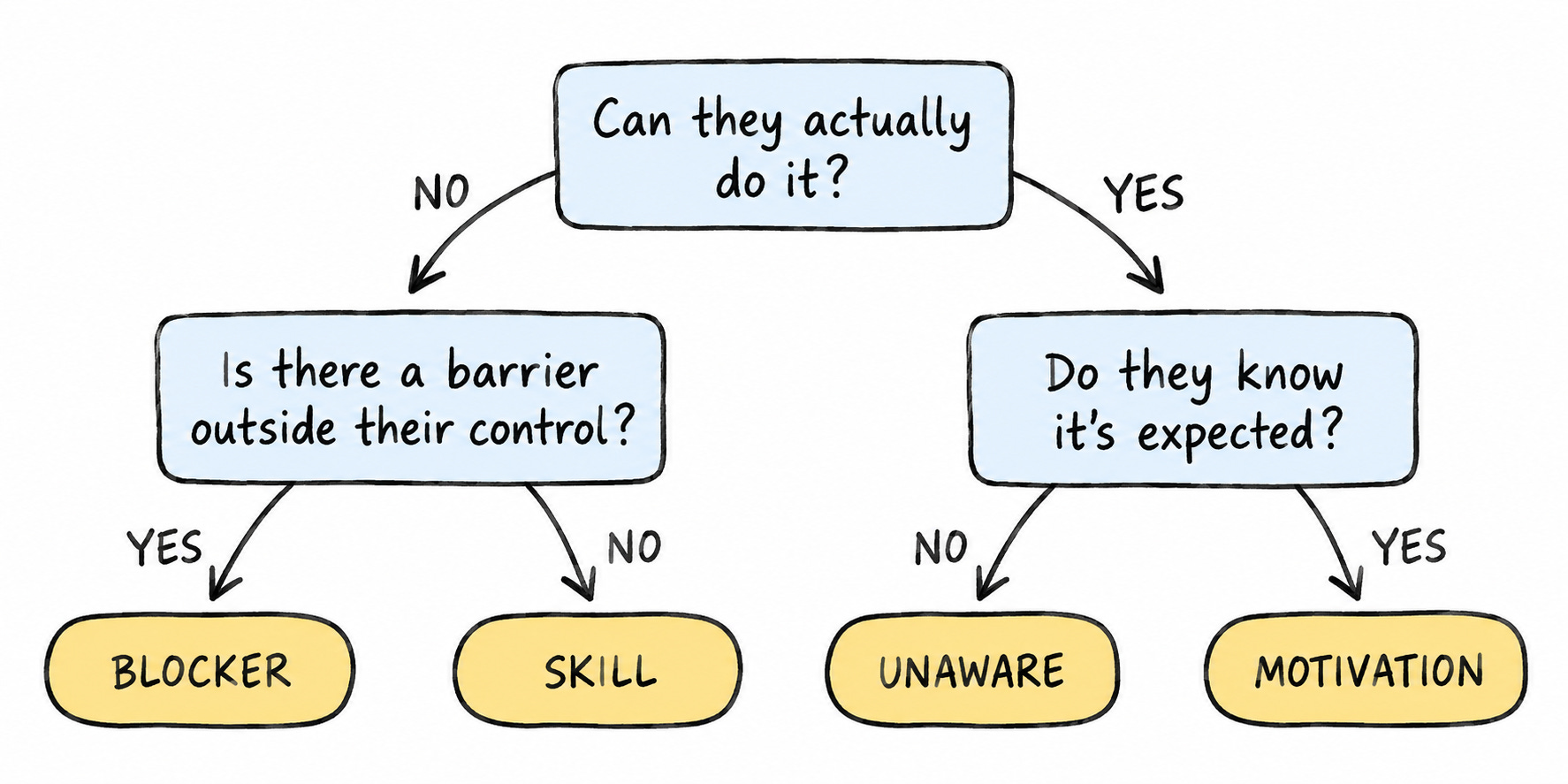
Start with the observed behavior. Be specific. Then test each explanation:
Is there a blocker I need to remove?
Have I actually made the expectation clear?
Does the person still want this job and this work?
Do they know how to do it?
You will often find more than one answer.
For example, a PM may not be conducting customer interviews because they do not know how to do them, researchers control customer access, and they are already a bit demotivated because nobody will help them get access.
That is Skill + Blocker + Motivation.
Welcome to people management. It is rarely as clean as a four-box framework.
Still, as in product management, understanding the real problem(s) is half the job.
Your job as a PM leader is to raise the bar of the team, make sure people get shit done, and help them achieve results.
Use BUMS.
And yes, I know. Terrible name.
But you will remember it.